Publications
County Magazine, Spring 2022
The mysterious, mythical Marysburgh Vortex
By Kenn M. Feigelman
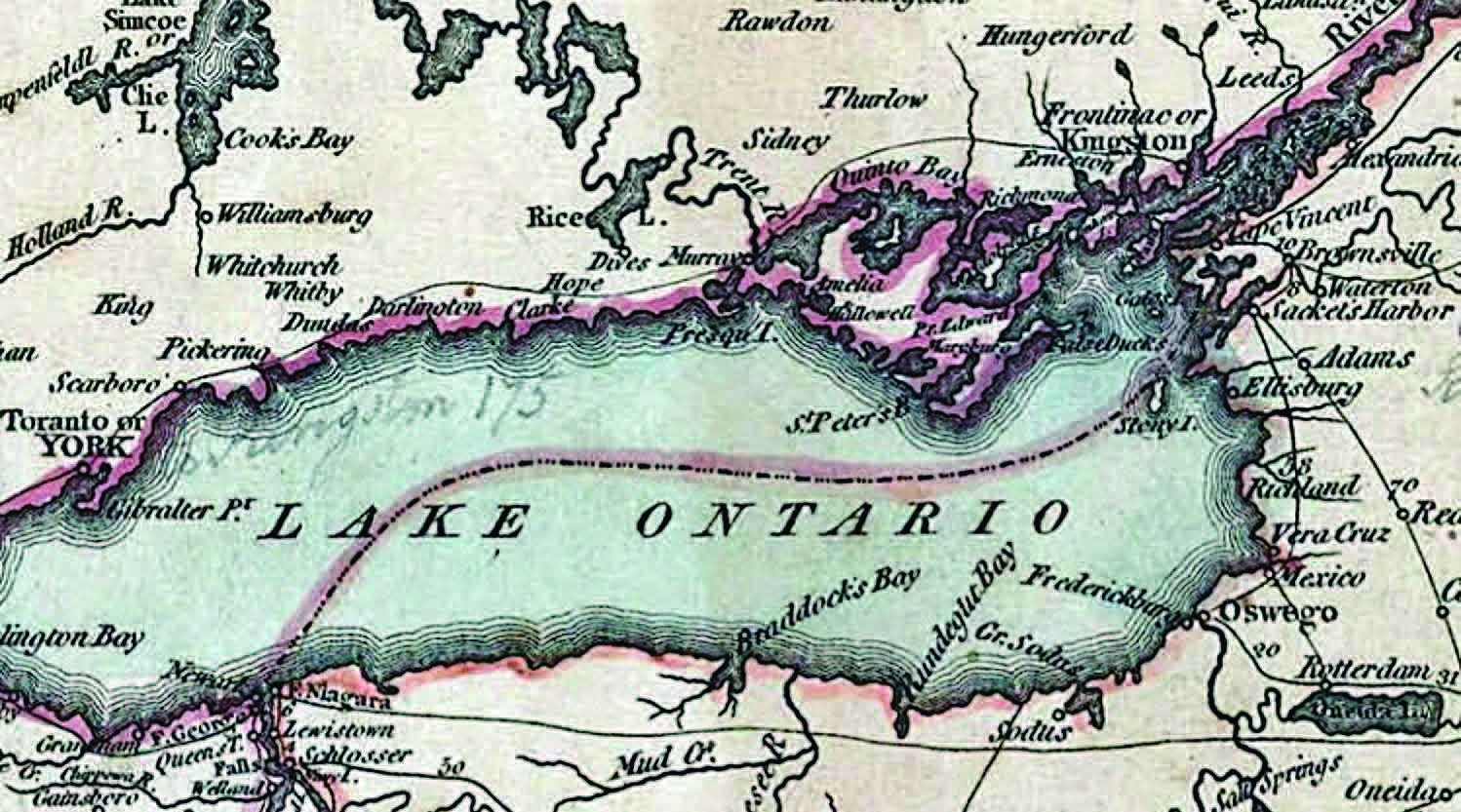
Vortex: an area of concentrated energy rising from the earth. Some believe that vortexes (vortices) are a portal for celestial and terrestrial spirits.
The site of scores of shipwrecks over many years, and many disappeared airplanes, the so-called Bermuda Triangle stretches south from the islands of Bermuda to Puerto Rico, and west to the Florida mainland. Since becoming known worldwide in the 1950s, the Bermuda Triangle has become something of a lightning rod for those believing in “otherworldly powers” at work, not unlike the alien mysteries believed to surround the infamous Area 51 in Nevada.
Closer to home, specifically off Prince Edward County, we have the treacherous waters of the so-called Marysburgh Vortex to ponder. It may not have captured the global imagination to quite the same degree as its more famous southern counterpart, but for centuries the “Vortex” has been known and feared by local residents, while spelling doom for many an unsuspecting mariner and airplane pilot. All the same, to this day most of the lost ships and aircraft have yet to be discovered.
Defining the Marysburgh Vortex
Find a nautical chart of Eastern Lake Ontario and draw an imaginary line from the rocky shores off Point Petre, the southernmost tip of Prince Edward County, across the lake in a south-easterly direction to Mexico Bay, off Oswego, New York. Now draw a line in a north-easterly heading, back across the lake to the far shores of Kingston. Complete the “Triangle” by extending your schematic back to your point of origin in the County.
The resulting “Triangle” delineates the so-called Marysburgh Vortex, which includes many islands: Amherst, Wolfe, Simcoe, Main Duck, False Ducks, Timber (“Snake Island”) and numerous smaller islets. Within this imaginary triangle, more than 450 ships are believed to have met their demise over the past few centuries. As well, many aircraft, both civilian and military, have disappeared within the “Vortex”.
There are, of course, shipwrecks throughout all of the Great Lakes. However, the eastern sector of Lake Ontario seems to have been exceptionally lethal to both sailing vessels and steamships. Of the many hundreds of shipwrecks slumbering on the cold, dark lake bed within the Marysburgh Vortex, about 80% have yet to be discovered.
While the Bermuda Triangle rose to fame in the mid-20th century, the reputation of the Marysburgh Vortex dates back earlier, to what might truly be considered the Golden Age of Great Lakes travel. Well before the advent of the trans-continental railroads, and later Highway 401, wooden sailing schooners were the primary mode of transportation for cargo and passengers on Lake Ontario.
Back then, the former South Marysburgh township (now a ward of the County; the townships were amalgamated in 1998) was a renowned shipbuilding hub for wooden schooners, as well as a major shipping port for grain, apples, corn, dairy products and lumber bound for upper New York State (primarily Oswego). These same sailing vessels, after unloading their varied cargoes in the U.S., would return to ports along Lake Ontario hauling heavy loads of coal and minerals, including phosphate.
As well as two- and three-masted sailing schooners “lost” within this mysterious region, there are scores of other types of long-drowned vessels slumbering on the lake bed, including steam-driven side-wheelers and stern-wheelers, both wooden and steel-hulled. Included among the missing are the gunboats of three different nations, Britain, France and the United States (another story for another day), dating back almost three centuries. More recently, in the age of flight, numerous aircraft, both civilian and military, have likewise disappeared in these dark, foreboding waters.
The Marysburgh Vortex was given its name by the late Canadian author Hugh F. Cochrane, in his 1980 book Gateway to Oblivion: The Great Lakes’ Bermuda Triangle. The “Marysburgh” portion of his title is understandable. The “Vortex” portion, not so much.
This is where the designation changes from a merely geographic location to suggesting something more ominous indeed. The word “vortex” refers to a whirling mass of fluid or air, such as a whirlpool or whirlwind. Due to their frightening nature, vortexes (or vortices) are believed by some to be portals for celestial and/or terrestrial spirits. The Vortex is a strange place, Cochrane writes, “where globes of light and weird fogs abound, and where ominous waters shroud sinister happenings. It is an enigma, featuring a long history of disasters, which have drained insurance companies of millions of dollars in claims.”
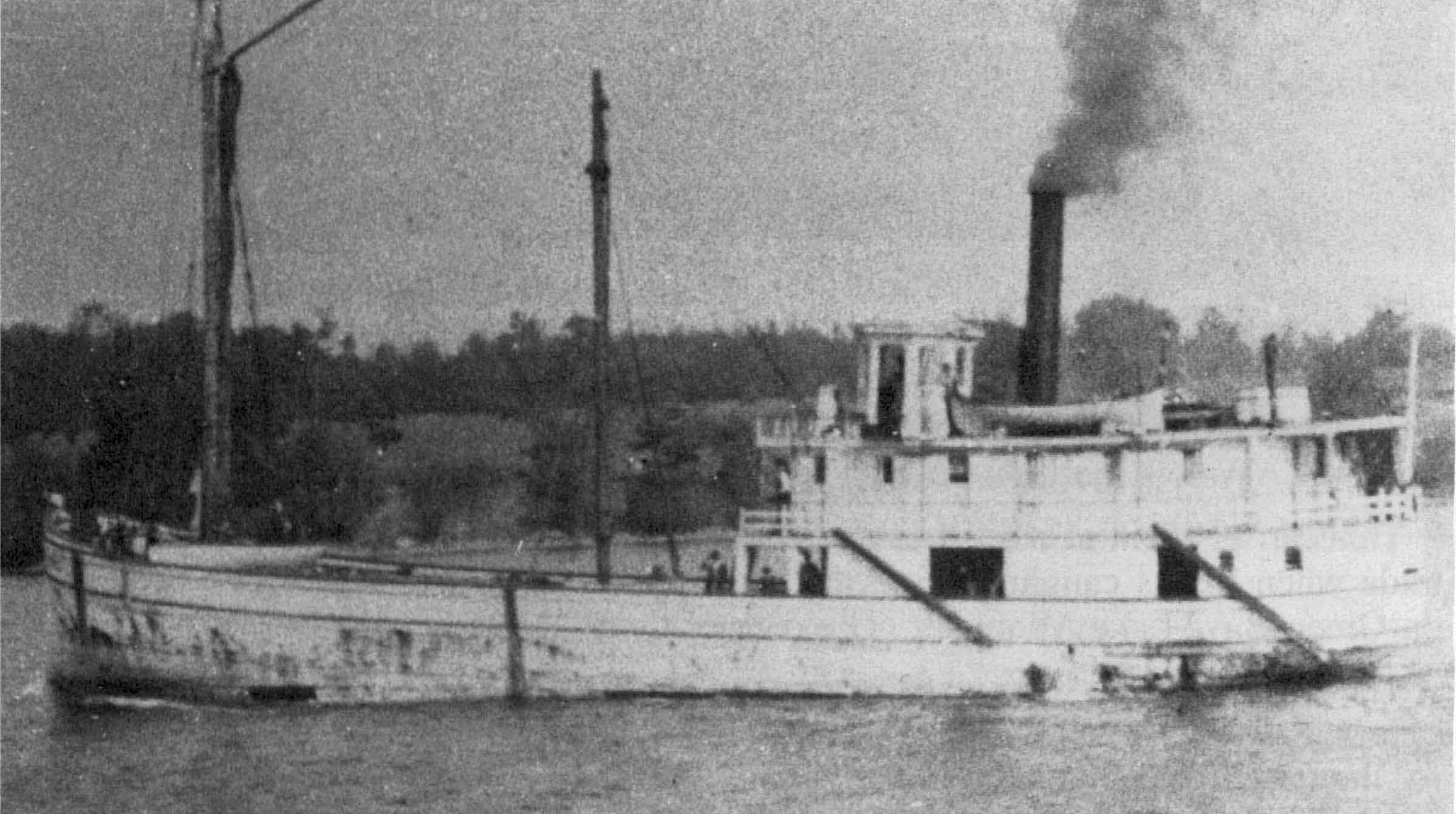
The Vortex devours the Waffle
On September 22, 1919, wreckage of an apparent wooden steamer washed ashore off Oswego, New York. Included in the flotsam were life preservers, each stencilled with T.J. Waffle. Also discovered on the rocky promontory were the doomed vessel’s deck house, with an attached fire axe, as well as mattresses, pillows, oars, shattered lifeboat davits, and even the lost ship’s helm and attached steering chain: all evidence of a catastrophic incident.
Built in Westport, Ontario in 1914, on the Rideau Lakes system, by master shipwright Joseph Paradis under contract to two local brothers, William and Walter Waffle, the wooden 112-foot steam-powered barge was designed specifically for carrying cargo to shallow-water ports up and down the Rideau system, including to and from Ottawa.
Mr. Paradis designed and built the wooden hull as a “scow-barge”, with a flat, rectangular bottom, a square stern and a slightly sloped bow. With a top speed of only six miles per hour, no cargo hatches and an open hold, a displacement of about 202 tons, a beam of 22 feet and just eight feet in depth, the T.J. Waffle was perfectly designed for the relatively shallow, calm waters of the Rideau system, where wave height seldom exceeds two feet. Fully laden, the ungainly wooden steamer drew less than three feet.
Walter Waffle christened the vessel T.J. Waffle, after his 15-year-old son, Thomas John. On March 16, 1916, Walter received a dreaded telegram announcing that his beloved son, aged only 17, had been killed in action on a First World War battlefield in France. Shortly after, Walter sold his namesake vessel to the Swift shipping family of Kingston for $12,000. Unreliable in stature and appearance, and definitely not designed for life on a freshwater sea, it was odd that the Swifts engaged the Waffle to haul relatively small loads of coal from Fairhaven or Oswego, New York, back to Kingston.
Her captain was Charles Beaupré; his first mate was Marshall Switzer of Kingston. There were at least four other itinerant crew members on board, paid in cash, whose names were never officially registered in the ship’s log. It is believed that a William Sweet was hired as a ship’s mate for the journey, as was his wife, Elizabeth. The ship’s engineer may have been Russell David of Picton. There also appears to have been at least one other unnamed crew member on board, and possibly two more.
On September 23, 1919, James Swift, president of Swift & Sons, owners of the ill-fated steam barge, sat nervously in his Kingston office on a gloomy, overcast afternoon, awaiting word of the now 16-hours-overdue vessel. Telephone calls across the lake confirmed that the wooden steamer had taken on 249 tons of coal in Fairhaven, N.Y. and was last seen departing for her home port of Kingston at about 10 a.m. on Monday the 22nd.
The crew of the steam tug Muscalonge believed they may have sighted the Waffle at around 5:30 p.m., ploughing through dangerously high whitecaps on a north-easterly heading and possibly changing course south for a safe haven. Neither the T.J. Waffle nor her crew of six to eight souls was ever seen again.
Only those who perished aboard the little wooden steamer knew what calamity truly occurred. The answers may rest, ultimately, on the deep, dark bed of Eastern Lake Ontario. Given the nature and size of the scattered flotsam that washed ashore on that bleak September day, some have speculated that the vessel’s coal-fired steam boiler may have exploded as she foundered in five- to six-foot seas.
As no explosion was reported by those on land or aboard other nearby vessels, there is also the theory that the little steam barge, not designed for the ravages of an angry Lake Ontario and overburdened with a heavy load of coal, riding dangerously low in savage seas, simply gave up, capsized and was battered to bits. Her overtaxed boiler may even have burst as the frigid waters engulfed the sinking ship. Until someone can positively identify a long-drowned debris field, possibly including a rusted old steam boiler, we will not truly learn the fate of the T.J. Waffle and her crew, devoured by the Marysburgh Vortex.
Looking for answers
While myths of a mysterious vortex are most enticing, the truth is far less mystical. Although various legends and theories hint at mysterious circumstances, marine historians today attribute the region’s record number of nautical disasters to more conventional sailing hazards: poor weather (sudden squalls from the south-west), shifting cargoes, fires, unseen reefs and shoals exposed during periods of low water and, most unusually, compass errors caused by natural geomagnetic anomalies, especially in thick fog.
Compasses have been known to spin wildly and even totally malfunction within the Marysburgh Vortex. This magnetic anomaly is still mentioned on present-day navigational charts. However, there is a theory behind this oddity that is rooted in science rather than superstition, though it is true that something extraterrestrial is to blame.
In the north-east end of Lake Ontario, about 12 km south-west of Wolfe Island and 25 km south of Kingston, the lake bottom shows evidence of what experts describe as an impact crater, about 460 million years old. Based on its composition, it appears a large meteorite crashed to Earth. The resulting Charity Shoal Crater, named for the Charity Shoal in which it rests, is between 1.2 and 1.4 kilometres across, with a maximum depth of around 19 metres. Buried there to this day are minerals associated with a meteorite impact (nickel-iron compounds), which affect the Earth’s natural magnetic field, causing ships’ compasses to deviate wildly and sending vessels off course into unknown shoals. While such compass confusion accounts for some of the area’s shipwrecks, it certainly doesn’t account for all. It seems the Marysburgh Vortex does not readily divulge its secrets.
The wreck of the Ocean Wave
Another tragic encounter happened on April 29, 1853, when the passenger and cargo steamer Ocean Wave burned and sank three miles off Point Traverse. Commanded by Captain Allison Wright, the Ocean Wave made a weekly round trip between Hamilton and Montreal. On this trip, it had departed Kingston with a full complement of passengers and a large shipment of tallow on board. The Ocean Wave was a cordwood burner. Captain Wright, who miraculously survived, said he believed the fire started when sparks from the funnel ignited the highly volatile tallow.
However it started, by about 2 a.m. the Ocean Wave was a flaming inferno, and most of the crew and passengers were still asleep in their bunks below deck. The second mate, who survived, later recounted that the blaze was so intense he was driven from the helm.
Toward the flames on the horizon and the screams of trapped victims, a Point Traverse farmer, David Dulmage, rowed more than two miles from shore. He arrived to find Captain Wright clinging to flotsam in the cold, dark lake. The vessel had apparently still been running under full steam when it sank, its lifeboats consumed by the inferno. Two other nearby vessels also rushed to the scene to rescue the few remaining survivors. Sadly, not everyone could be saved: in all, 13 passengers and 15 crew members perished.
At the time of the disaster, the Ocean Wave was less than one year old, having been built in Montreal for the famous Molson family. It was said that all the company’s earnings for that year, in cash, gold and silver, were stored in the purser’s safe for eventual deposit in a Montreal bank. It was also said that the body of the ship’s purser washed up weeks later on the shore of Lake Ontario near West Point, with a large sum of money concealed in his belt, in very good condition. To this day, rumours persist that the purser’s undiscovered safe, with contents worth tens of thousands of dollars, rests beneath the scorched bones of the long-drowned shipwreck.
Conclusion
With the advent of radar, sonar and GPS, mariners no longer rely solely on a ship’s compass and charts to plot a safe course. Shipbuilding standards have changed dramatically, as have on-board safety devices and search and rescue techniques. And ships are no longer the only way to move people and goods, so the frequency of shipwrecks in the Marysburgh Vortex has vastly diminished.
Likewise, modern science finds no reason to believe that any supernatural or paranormal activity exists within the so-called Marysburgh Vortex: no alien beings or crystal pyramids. The area is simply a very historic, well-travelled swath of Eastern Lake Ontario, prone to sudden, voracious storms, blinding fog banks, misleading compass bearings (due to geomagnetic anomalies) and countless hidden shoals and rocky reefs.
Combine those with deadly fires caused by an ill-placed oil lamp or other source of ignition, add instances of poor seamanship or faulty decision-making, as well as questionable ship construction, and we have the recipe for maritime disaster, whereby hundreds of vessels have disappeared beneath these dark, unforgiving waters.
Until what lies beneath is explored in greater depth, the Marysburgh Vortex will remain an enigma, and the fate of the many vessels it has claimed over the centuries, and the souls lost with them, will remain a source of speculation and unresolved mystery.
“For in their interflowing aggregate, these grand Freshwater Seas of ours, Erie, Ontario, Huron, Superior and Michigan, possess an ocean-like expansiveness; with many of the ocean’s noblest traits, with many of its rimmed varieties of races and climes.”
“They contain round archipelagos of romantic isles, even as the Polynesian waters do; in large part, are shored by two great contrasting nations, as the Atlantic is … they know where shipwrecks are, far out of sight of land, however, in-land, they have drowned many a midnight ship with all its shrieking crew.”
Herman Melville, Moby-Dick, 1851